
Event-Driven Email Marketing Automation: How It Increased eCommerce Revenue on BigCommerce
(in box/Jumbotron)Key Takeaways
- Event-driven marketing fires campaigns based on real user behaviour, not a schedule
- Identity mapping before dispatch ensures purchases are never recorded as anonymous
- Session storage maintains consistent product data across all BigCommerce funnel pages
- Timestamp format YYYY-MM-dd HH:mm:ss is required for Netcore journey triggers to fire correctly
- Proper data types in payload (numeric price, ISO currency) prevent attribution errors
- Implementation resulted in 14% more repeat purchases and 18% higher automation revenue in 6 months
Most ecommerce stores capture behavioural signals but fail to operationalize them. Product views, cart additions, and purchases are tracked but not structured for targeting, timing, or personalization. Data remains fragmented across platforms, so high-intent ecommerce users drop without follow-up. Campaigns continue on broad segments while real-time behaviour is ignored, limiting conversion efficiency and revenue capture in ecommerce email marketing. The implementation covered the full ecommerce customer funnel from first product view to purchase completion. Each event followed strict data standards so automation workflows triggered accurately and revenue was attributed to the correct user across sessions.
What Is Event-Driven Marketing in eCommerce?
Event-based marketing triggers campaigns based on real user actions such as product views, cart additions, or purchases. It operates on behavioral signals in real time rather than fixed schedules or predefined send times.
| Type | How it sends | Based on | Result |
| Batch/Blast Email | Scheduled blasts to a full list | Calendar or campaign plan | Low relevance, high drop-off |
| Drip Campaigns | Pre-set sequence over time | Time delays after signup or action | Moderate relevance, limited intent capture |
| Event-Driven | Real-time triggers per user action | Live behavior signals | High relevance, stronger conversion rates |
This is the foundation of modern eCommerce email marketing for stores that want to convert behaviour into revenue.
Batch/blast email fails DTC brands because it treats all users the same regardless of intent. Batch campaigns also damage email deliverability over time due to low engagement signals.
How Event-Driven Marketing Automation with Netcore CEE Increased eCommerce Revenue on BigCommerce
Building on this principle, we implemented an event-driven automation system on BigCommerce using Netcore CEE as part of our BigCommerce digital marketing services. Funnel tracking covered the full customer journey from first product view to purchase completion. Each event was structured with strict data standards so automation workflows triggered without delays and revenue attribution remained accurate across sessions and devices.
Funnel Events
- Product View
- Search
- Add to Cart
- Remove from Cart
- Checkout
- Register
- Login
- Purchase
Data Standards
- Standardised product ID
- Structured payload format
- Proper data types
- Timestamp format YYYY-MM-dd HH:mm:ss
- Device detection
- Identity mapping before dispatch
Supporting this level of tracking consistency often requires structured technical SEO and data architecture as a foundation.
Funnel Tracking (What Is Tracked)
The full customer journey was tracked end to end across all key interaction points. Each stage triggered an automation workflow in Netcore CEE based on user behaviour.
Product View → Search → Add to Cart → Checkout → Purchase
To make this work seamlessly on BigCommerce, two key technical foundations were established: a structured product data layer combined with session storage for cross-page consistency, and identity resolution to eliminate anonymous events.
Product Data Layer and Session Storage (How Data Is Captured)
Structured Product Data Layer Setup
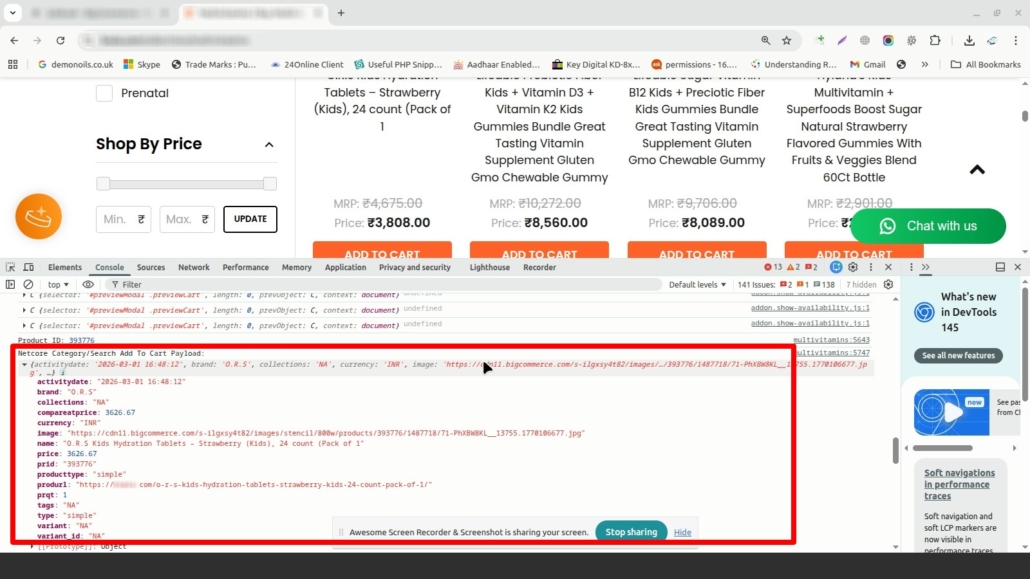
A product data layer is a structured JavaScript object that stores product attributes in a consistent format for tracking and automation. In BigCommerce, product pages contain full product data, but this structure often changes on cart pages and is not reliably available on order confirmation pages due to API dependency. This creates breaks in event tracking, where key attributes such as product ID, price, or category may be missing or altered when events fire.
window.productData = {
  product_id: "12345",
  name: "Vitamin C Tablets",
  category: "Supplements",
  price: 499,
  currency: "INR"
};
Cross-Page Data Persistence Using Session Storage
Session storage preserves product data at the browser level so it remains accessible across pages without relying on API responses. The data captured on the product page is reused on cart and order confirmation pages, maintaining consistency across the funnel.
// Store on product page
sessionStorage.setItem("product_data", JSON.stringify(window.productData));

// Retrieve on cart or order confirmation page
const product = JSON.parse(sessionStorage.getItem("product_data"));
Advantages of implementing the product data layer with session storage
- Consistent data across funnel steps
- Reduced API dependency.
- Faster execution
- Improved reliability
Identity Resolution Layer (Who the Data Belongs To)
Identity in eCommerce tracking ensures every user action is linked to a real customer profile using an identifier such as email. This linkage connects behaviour across sessions, devices, and channels, making attribution, lifecycle tracking, and personalisation possible.
In the initial setup, a large portion of purchase events were anonymous. No email was attached and no user profile was linked. This breaks attribution, lifecycle tracking, personalisation, and revenue analysis. Attribution gaps also affect SEO measurement, which is why eCommerce SEO packages begin with a tracking audit. Without identity resolution, events exist but cannot be tied to a user journey.
3-Step Identity Resolution Process
- User identified using email
- User profile updated in Netcore CEE
- Purchase event dispatched
const identifyAndDispatch = async (userEmail, orderData) => {
  // Step 1: Identify user in Netcore CEE
  await fetch('https://api.netcorecloud.com/v1/identify', {
    method: 'POST',
    headers: {
      'api_key': 'YOUR_NETCORE_API_KEY',
      'Content-Type': 'application/json'
    },
    body: JSON.stringify({
      identity: userEmail,
      type: "identify",
      attributes: {
        identified_at: new Date().toISOString(),
        platform: "bigcommerce"
      }
    })
  });
  // Step 2: Retrieve fallback product data
  const productData = JSON.parse(sessionStorage.getItem("product_data"));
  // Step 3: Dispatch Purchase event
  await fetch('https://api.netcorecloud.com/v1/events', {
    method: 'POST',
    headers: {
      'api_key': 'YOUR_NETCORE_API_KEY',
      'Content-Type': 'application/json'
    },
    body: JSON.stringify({
      identity: userEmail,
      type: "event",
      name: "product_purchase",
      date: new Date().toISOString()
              .replace('T',' ').slice(0,19),
      attributes: {
        order_value: orderData.total,
        product_id: productData?.product_id
                    || orderData.product_id,
        quantity: orderData.quantity,
        currency: "INR"
      }
    })
  });
};
Product Purchase Event with Identity Mapping
The purchase event is the most critical event in the funnel because it captures the highest-value transaction data. It must never fire anonymously, as that breaks attribution and downstream automation. Identity mapping is executed before dispatch so the event is always tied to a known user.
Captured Data
- Order value
- Product IDs
- Quantity
- Currency
- Timestamp
- Customer email
- Fallback product data from session storage
Critical Enhancement
Before the Product Purchase event fires:
- User is identified using email
- Profile is updated in Netcore CEE
- Event is dispatched
This ensures every purchase is attributed to a known user and not recorded as anonymous activity.
Measurable Outcomes After Identity Resolution
- Attribution accuracy: Revenue is mapped to actual users and campaigns instead of anonymous sessions.
- Lifecycle tracking: Full journey visibility from first interaction to repeat purchase.
- Segmentation quality: Audiences are built on real behavior tied to known users.
- Personalisation: Messaging aligns with user actions, not generic segments.
- Revenue analysis: Clear linkage between campaigns, users, and transactions.
The same identity-first approach applies across platforms. See how it is implemented in Klaviyo email automation for Shopify stores.
Results After 6 Months of Netcore CEE Implementation on BigCommerce
14% increase in repeat purchases
22% growth in customer lifetime value
18% increase in automation-driven revenue
These results were driven by fixing data consistency and execution gaps. The product data layer removed tracking breaks across BigCommerce pages, so events carried complete and reliable attributes. Identity resolution reduced anonymous purchase events by linking transactions to user profiles. Netcore CEE journeys triggered real behaviour such as product views, cart actions, and purchases, which improved timing and relevance of communication. Clean, structured data creates a stable foundation for predictable and scalable ecommerce revenue growth.
Why Netcore CEE Works for eCommerce Growth
Netcore CEE enables ecommerce growth by combining behavioural segmentation, personalised communication, lifecycle automation, and AI-driven optimisation into one execution layer. Netcore integrates directly with our email marketing services setup for eCommerce brands on BigCommerce. Behavioural segmentation groups users based on real actions, personalised communication aligns messaging with intent, lifecycle automation triggers at each funnel stage, and AI optimisation refines timing and content for higher conversions. Proper identity mapping also directly helps improve email deliverability by reducing bounces and spam complaints from unmatched profiles. Accurate identity is what makes all four work; without it, every capability runs on incomplete data. Implement this structure to convert behaviour into revenue.
If your BigCommerce store is not sending identified event data to your email platform, you are losing attribution accuracy and automation-driven revenue. Fix the tracking layer and identity flow before scaling campaigns.
About the Author
Subhash leads Samyak Online, a digital marketing agency focused on ecommerce growth through structured tracking and execution. His work centers on data layer architecture, identity mapping, and event-driven automation across platforms like BigCommerce, Netcore, and Klaviyo. He works closely with ecommerce brands to fix attribution gaps, improve email performance, and build systems where behavioural data directly drives revenue.
FAQs
It is a system where user actions trigger automated campaigns in real time.
It connects events to real users, improving personalization and attribution.
Yes, through structured event tracking and real-time data integration.
Yes, by improving conversions, retention, and customer lifetime value.
Leave a Reply
Want to join the discussion?Feel free to contribute!