
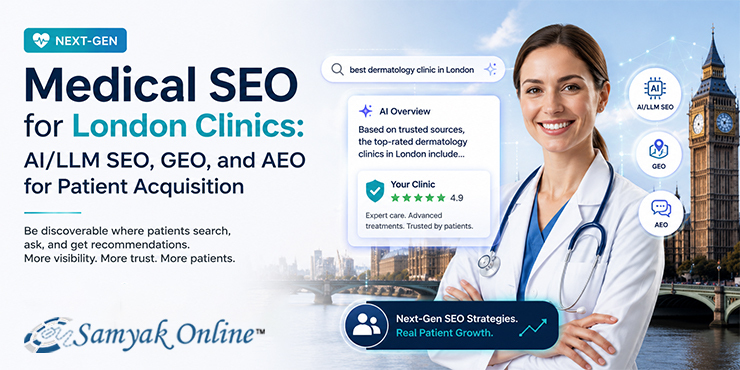
Next-Gen Medical SEO for London Clinics: AI/LLM SEO, GEO, and AEO for Patient Acquisition
Key Takeaways
- atients increasingly use ChatGPT, Google AI Overviews, Perplexity, and voice assistants when researching healthcare providers.
- AI/LLM SEO helps clinics appear in AI-generated recommendations before a patient visits a website.
- GEO (Generative Engine Optimization) focuses on making healthcare content easier for AI systems to cite and reference.
- AEO (Answer Engine Optimization) helps clinics appear as direct answers for healthcare-related queries.
- Medical websites require accurate structured data, strong E-E-A-T signals, and locally relevant content.
- London healthcare providers benefit from combining Local SEO, Technical SEO, Content Optimization, and AI SEO into a single strategy.
Private healthcare providers across London compete for visibility in highly competitive search environments. Patients searching for dermatologists, dentists, orthopedic specialists, physiotherapists, fertility clinics, and private hospitals now receive recommendations not only from search engine results but also from AI-generated answers.
A patient may ask ChatGPT, Google AI Overviews, or Perplexity questions such as:
- Which private orthopedic clinic in West London specializes in knee treatment?
- Which dermatologist in Chelsea accepts private insurance?
- What is the best private dental clinic near Kensington for cosmetic dentistry?
In many cases, the user receives recommendations directly within the AI-generated response. This means healthcare providers must optimize their digital presence for both search engines and AI-driven discovery platforms.
AI/LLM SEO is the practice of helping a healthcare provider appear within these AI-generated recommendations. The lead often happens before a website visit and before a patient completes a contact form.
Medical Entity Optimization and Structured Data
AI systems rely heavily on entities. They need to understand who the clinic is, where it operates, what services it provides, and which specialists are associated with the practice. Healthcare websites should clearly define:
- Medical specialties
- Treatment areas
- Physician profiles
- Clinic locations
- Insurance partnerships
- Consultation options
- Operating hours
Structured data helps search engines and AI systems process this information accurately.
For multi-location healthcare businesses, proper schema implementation also strengthens Local SEO visibility across different London boroughs.
Building Content That AI Systems Can Reference
Healthcare content should answer real patient questions.
A patient researching knee surgery is looking for information about symptoms, treatment options, recovery expectations, specialist credentials, and consultation requirements. AI systems often pull information from pages that explain these topics clearly and accurately.
Instead of creating large volumes of shallow content, clinics benefit from building topic clusters around core treatment areas.
1. Orthopedic SEO Content
- Knee replacement procedures
- Sports injury treatment
- Arthroscopy recovery timelines
- Orthopedic consultation guides
2. Dental SEO Content
- Invisalign treatment options
- Dental implants
- Cosmetic dentistry procedures
- Emergency dental care
3. Dermatology SEO Content
- Acne treatment
- Skin cancer screening
- Rosacea management
- Cosmetic dermatology procedures
These content hubs support both organic rankings and AI-generated search visibility.
Local SEO Remains Critical for London Clinics
Most healthcare searches include a location component.
Patients search for providers near Harley Street, Chelsea, Kensington, Westminster, Richmond, Canary Wharf, and other London districts.
AI systems also consider location relevance when generating recommendations.
To improve local visibility, clinics should maintain:
- Accurate Google Business Profile information
- Consistent business citations
- Location-specific service pages
- Patient reviews
- Structured location data
Strong local signals help search engines verify clinic information and improve the chances of appearing in AI-generated recommendations.
E-E-A-T and Medical Trust Signals
Healthcare falls within Google’s Your Money or Your Life category, where accuracy and trust are especially important.
Patients expect reliable information before making healthcare decisions. AI systems also prioritize trustworthy sources when generating medical recommendations. Clinics should clearly demonstrate:
- Professional qualifications
- Medical expertise
- Author credentials
- Regulatory compliance
- Verified contact information
- Patient-focused educational content
These trust signals support both organic search visibility and AI-generated citations.
Why Technical SEO Supports AI Search Visibility
AI systems can only reference information they can easily access and understand.
Technical issues such as crawl errors, slow-loading pages, duplicate content, poor internal linking, and missing schema markup can limit visibility. Healthcare websites should regularly review:
- Site architecture
- Mobile usability
- Core Web Vitals
- Structured data implementation
- Indexation status
- Internal linking structure
Technical SEO creates the foundation that allows content, local optimization, and AI/LLM SEO efforts to perform effectively.
How Samyak Online Supports Healthcare Businesses
Samyak Online provides SEO solutions for healthcare providers looking to improve visibility across Google Search, Google Maps, ChatGPT, Perplexity, Google AI Overviews, and voice assistants. Our services include:
- AI/LLM SEO Services: Helping healthcare providers improve visibility within AI-generated answers and recommendations.
- Local SEO Services: Supporting clinics targeting patients across London boroughs and surrounding areas.
- Technical SEO Services: Improving crawlability, indexing, schema implementation, page performance, and site architecture.
- Healthcare Content Optimization: Creating structured medical content that aligns with patient intent and AI search requirements.
- SEO Outsourcing Services: Supporting healthcare marketing agencies and organizations requiring dedicated SEO execution.
- On Page SEO
- Off Page SEO
- Voice Search SEO Services
Conclusion
Medical search visibility now extends beyond search engine rankings. Patients increasingly discover healthcare providers through AI-generated answers across ChatGPT, Google AI Overviews, Perplexity, and voice assistants.
Clinics that combine AI/LLM SEO, GEO, AEO, Local SEO, Technical SEO, and structured healthcare content are better positioned to appear when patients research symptoms, treatments, and specialists.
For healthcare providers in London, the objective is not simply ranking for keywords. The objective is becoming a trusted and verifiable source that search engines and AI systems can confidently recommend when patients are actively seeking care.