
10 AI Powered Marketing Ideas to Help Travel Agents Get More Bookings in 2026
Key Takeaways: At a Glance
- Use AI to identify high-interest travel keywords and emerging destination trends.
- Create personalized travel content for different customer segments.
- Use AI chatbots to answer common questions and capture leads around the clock.
- Optimize destination and package pages for search engines and AI-powered search.
- Use predictive analytics to understand customer behavior and improve campaigns.
- Automate email and remarketing campaigns without sacrificing personalization.
- Rapidly generate social media ideas and content using AI-assisted workflows.
- Use AI to optimize paid advertising and improve campaign performance.
- Empower your website with conversion-focused content and personalized recommendations.
- Combine AI with expert human assistance to create a more reliable booking experience.
The global AI market in the travel sector is projected to reach $222.4 billion by 2026, growing at a CAGR of 34% as consumer behavior undergoes fundamental shifts. Today’s travelers seek instant responses, personalized travel itineraries, and seamless direct booking experiences. Recent industry data reveals that 62% of travelers now use AI-based tools to research or plan their trips, and 58% state that AI-generated recommendations directly enhance their planning experience.
For forward-thinking travel agencies, AI streamlines every stage of the modern marketing funnel from predictive keyword research and generative SEO to dynamic audience segmentation, AI chatbots, and optimized ad spend. However, technology is only half the story; AI works best when it augments human insight and experience. Combining data-driven AI with authentic local destination knowledge builds the trust needed to convert serious site visitors into loyal, long-term booking customers.
This guide outlines 10 practical AI-powered marketing ideas that travel agents can use in 2026 to boost their visibility, generate leads, and secure more bookings.
1. Use AI to Find High Intent Travel Keywords
Keyword research is the backbone of attracting high-intent travelers, and AI agents are transforming how opportunities are identified. By analyzing vast datasets, advanced language models uncover shifting search patterns, seasonal changes, and long-tail query variations long before traditional search tools signal them.
Instead of competing for broad and expensive terms like “travel agency” or “holiday package,” AI identifies specific, conversion-ready search strings that reflect the traveler’s true intent:
- Commercial and Transactional Queries: “Affordable Bali packages from Delhi,” “Luxury Maldives packages,” “Family holiday packages for Dubai.”
- Research and Destination-Related Queries: “Best time to visit Switzerland,” “Visa requirements for Thailand,” “Best places for a honeymoon in Europe,” “Weekend trips from Mumbai.”
By incorporating AI-driven research into your customized digital marketing for travel and tourism, you ensure that your blog posts reach people conducting initial research, while your package pages attract travelers ready to book.
2. Create Personalised Travel Content via Generative AI
Today’s travelers seek personalized recommendations tailored to their travel styles, budgets, and group requirements. Generic holiday brochures are no longer effective. With the help of generative AI, travel agencies can present the story of a single destination in distinct and highly impactful ways for different types of travelers:
- Families: Emphasizes family-friendly resorts, convenient transport, and stress-free itineraries.
- Honeymooners and couples: Focuses on boutique villas, private dining, and romantic excursions.
- Adventure seekers and solo travelers: Focuses on offbeat destinations, safety tips, and social hostel networks.
- Luxury and corporate clients: Highlights executive lounges, VIP access, and premium concierge services.
AI speeds up challenging tasks such as creating headlines, social media captions, email subject lines, and outline structures:
- Prompt Input: “Create 3 email openers for a 5-day Bali package: 1 for families, 1 for luxury couples, and 1 for solo backpackers.”
- AI Output: Custom-tailored variations are generated in seconds, matching the precise tone and pain points of each demographic.
While AI accelerates content creation, successful agencies avoid publishing generic, mass-produced copy. Real conversions happen when travel advisors review AI drafts and incorporate authentic destination details, the latest pricing, insider tips, and original photos ensuring the content remains trustworthy, accurate, and genuinely traveler-focused.
3. Optimise Travel Websites for AI Search and Organic SEO
The way travelers search has changed, as they now simultaneously use generative search engines, conversational engines, and traditional search engines. To maintain visibility, travel agencies must create destination pages that are effectively tailored for both human readers and AI crawlers.
Your destination landing page should act as a reliable guide, clearly answering essential questions related to the trip:
- Essential Information: Best time to visit, estimated budget, visa requirements, and local transport.
- Special Experiences: Family-friendly itineraries, honeymoon destinations, and excellent accommodation options.
- Organized FAQs: Clear and direct answers to common travel-related queries and concerns.
To help AI systems index and understand your travel packages and cite them in generated search results, organize your content using a clean technical architecture:
- Clear Section Headings (H2/H3 Tags)
- Schema Markup (Trip, TouristAttraction, FAQPage)
- Descriptive Page Titles & Semantic Entities
- Contextual Internal Links (To Specific Package Pages)
Partnering with a specialized travel AI SEO service helps agencies implement the entity mapping and advanced schema architecture essential for AI discovery. However, AI optimization should enhance core SEO fundamentals such as technical site speed, mobile optimization, high-quality backlink profiles, and intuitive user navigation rather than replace them.
4. Build AI Powered Travel Chatbots
Travelers planning trips online expect immediate responses, regardless of time zones. AI-based travel chatbots act as 24/7 digital concierge assistants and provide instant answers to common pre-booking questions, such as:
- “Do you have a 7-day custom Dubai itinerary?”
- “Are airport transfers included in this package?”
- “What are the current visa entry requirements for Thailand?”
- “Which resorts in Bali offer kid-friendly amenities?”
Beyond answering basic questions, AI chatbots systematically qualify incoming web traffic by gathering essential lead information before routing inquiries to your sales team:
| Lead Qualification Data | Example Collector Inputs |
| Primary Intent | Destination preference, trip style (e.g., Luxury, Adventure, Family) |
| Logistics & Budget | Travel dates, total group size, estimated price range |
| Contact Details | Name, email address, WhatsApp/phone number |
Web Visitor Ask ──► AI Chatbot Instant Answer ──► Lead Info Capture ──► Live Agent Handoff
To maintain trust, adopt a hybrid service model. While AI excels at handling routine inquiries and lead capture, complex booking changes, customized multi-stop itineraries, and sensitive questions regarding cancellations should be automatically routed to experienced human travel advisors.
5. Use Predictive Analytics to Understand Traveller Behaviour
Predictive analytics leverages machine learning to gather data such as historical booking trends, user browsing patterns, and real-time on-site behavior and transforms raw data into actionable sales strategies. Instead of relying on guesswork, agencies can identify hidden signals of conversion even before a traveler fills out an inquiry form.
By using machine learning models, travel agencies can optimize the key factors that drive revenue:
- Prioritizing leads: Assign higher value scores to visitors who show greater interest in making a purchase (such as those spending time on pricing tables or custom itinerary planners). This enables sales teams to contact the most promising prospects first.
- Timing campaigns effectively: Predict peak booking periods for specific destinations and launch paid ads and email sequences precisely when demand is highest.
- Targeted remarketing: Automatically display customized ad offers based on the specific pages visitors have viewed for example, showing private tour add-ons to users who have browsed luxury resort pages.
- Optimized budget allocation: Reallocate marketing budgets toward packages and regions where search activity is surging in real-time.
There can be no compromise on data privacy. Agencies must ensure that all predictive data collection strictly adheres to international privacy regulations (such as GDPR) and maintains processes for obtaining explicit user consent.
6. Automate Personalised Email Marketing
For travel agencies, email marketing is one of the highest-converting channels, as decision-making for major, high-value trips takes time. AI transforms standard email blasts into dynamic, fully personalized engagement workflows based on user behavior and past interaction history.
- Day 1: “Top 5 Boutique Hotels in Amalfi”
- Day 3: “Exclusive Europe Package Discount”
- Day 5: “Essential Schengen Visa Guide”
Instead of sending the same newsletter to your entire list, AI-based automation segments the audience so that highly relevant and useful information can be sent to them:
- Family-Focused Subscribers: Automatically receive resort recommendations, special offers for school holidays, and stress-free packing checklists.
- European Culture Enthusiasts: Get exclusive updates on new seasonal tour itineraries, changes to visa regulations, and multi-country rail tour packages.
- Inactive Leads: Receive automated re-engagement messages featuring exclusive, limited-time discounts for destinations they previously viewed.
AI platforms continuously improve email delivery. To achieve this, they test subject lines to boost open rates, modify content, and determine the optimal time to send emails to each subscriber based on past open patterns.
7. Create Better Social Media Content With AI
Since the travel industry is primarily visual, platforms like Instagram, Facebook, YouTube, and TikTok serve as major sources of inspiration for people during the initial stages of travel planning. AI tools reduce the time and effort involved in social media planning by rapidly transforming a single promotional concept into a multi-channel content series.
Instead of starting with a blank page, travel marketers can use AI to create the following:
- Multi-week content calendars: Post schedules tailored to the upcoming holiday season or long weekends.
- Video and Reel scripts: Engaging short-form video hooks, visual shot lists, and call-to-action scripts for TikTok and Instagram Reels.
- Varied interactive content: Carousel outlines, destination-themed trivia polls, travel tips, and caption options designed for specific buyer personas.
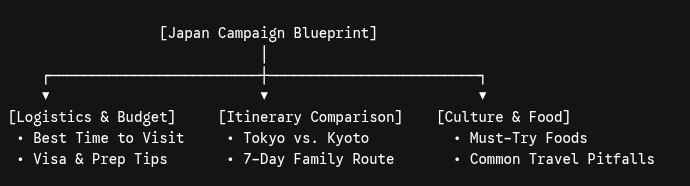
For example, when launching a promotional campaign for Japan, an agency could use AI to outline a structured, eight-part content series based on key topics of interest to travelers:
8. Use AI to Improve Paid Advertising
Paid digital advertisements on search engines and social platforms offer immediate visibility, but marketing budgets can be quickly exhausted due to precise audience targeting. AI-powered advertising tools eliminate budget wastage by automating audience segmentation, dynamic creative testing, and real-time performance optimization.
By using AI tools on platforms like Google Ads and Meta Ads, travel agencies can automatically tailor their ad copy to match users’ specific search intent and demographics.
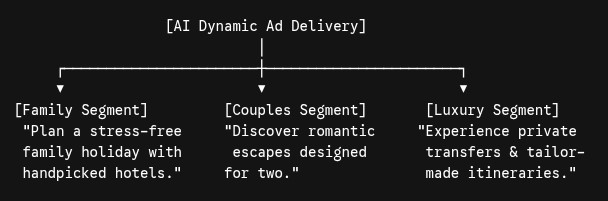
In addition to dynamic ad creatives, AI optimization delivers a higher Return on Ad Spend (ROAS) in the following ways:
- Predictive Audience Matching: Identifies high-converting ‘lookalike audiences’ based on existing client booking data.
- Automated Budget Reallocation: Shifts ad spend in real-time toward the best-performing keywords, ad placements, and geographic regions.
- Multivariate Creative Testing: Tests dozens of combinations of headlines, images, and calls-to-action simultaneously to identify the highest-converting variations.
While AI-driven automated bidding strategies handle minor, real-time adjustments, human marketers should still maintain strategic control. Regular manual reviews are essential to modify campaign parameters whenever there are changes in travel demand, destination entry requirements, seasonal pricing, or market competition.
9. Use AI to Improve Travel Landing Pages
Driving the right kind of visitors (qualified traffic) to your website is only half the battle; the real challenge lies in converting those visitors into confirmed inquiries and bookings. AI tools help agencies overcome conversion barriers by analyzing user heatmaps, session recordings, and drop-off points to optimize page performance.
Agencies can use AI-powered Conversion Rate Optimization (CRO) platforms to run automated multivariate tests on key page elements:
- Action-oriented CTAs: Test high-intent phrases like “Get My Custom Trip Quote” or “Plan My Itinerary” against generic options like “Submit.”
- Dynamic headlines: Match the headline copy directly to the search query that brought the user to the page (e.g., “Custom 7-Day Luxury Bali Packages” vs. “Affordable Family Bali Trips”).
- Form field optimization: Test shorter lead forms and multi-step interactive quizzes to see which format generates higher lead volume without compromising lead quality.
Since even a 1% to 2% increase in conversion rates can generate significantly higher booking revenue from existing web traffic, continuously optimizing landing pages using AI has a direct impact on your profits.
10. Combine AI With Human Travel Expertise
The biggest mistake travel agencies can make is assuming that artificial intelligence alone can manage the travel business. The travel industry is fundamentally built on emotions and experiences; travelers seek human trust, accurate destination information, and peace of mind, knowing that an expert is available to resolve any unexpected issues that may arise during their journey. AI excels at speed, pattern recognition, and data processing, whereas human advisors are better at empathy, understanding nuances, and resolving work-related problems.
| AI Responsibilities (Scale & Velocity) | Human Advisor Value (Trust & Nuance) |
| Data Analysis & Pattern Discovery: Spotting search trends and high-intent keywords. | Complex Itinerary Architecture: Designing intricate, multi-stop international tours. |
| Task Automation: Sending instant email triggers, lead routing, and report generation. | Real Destination Insights: Recommending authentic local dining and hidden gems. |
| Personalization at Scale: Generating custom landing page copy and dynamic ads. | Crisis Management: Resolving flight cancellations, visa delays, and emergency changes. |
| 24/7 Initial Engagement: Answering routine FAQs via intelligent chatbots. | High-Value Relationship Building: Closing luxury tour packages through personal consultation. |
How Travel Agents Can Build an AI Marketing Strategy in 2026
You don’t need to adopt every technology overnight to implement AI in your travel agency. A practical approach that yields higher returns is to take small steps that immediately improve conversions.
Step 1: Audit Your Existing Digital Assets
Analyze current website performance to identify pages that receive organic traffic but have low inquiry rates. Use AI crawling tools to detect technical SEO issues, weak content, missing schema markup, or ineffective calls-to-action (CTAs).
Step 2: Define and Segment High-Value Audience Clusters
Segment your existing customer database based on booking methods, travel frequency, budget, and destination preferences. Categorizing your audience into distinct groups such as couples taking luxury trips versus families traveling together enables targeted AI automation.
Step 3: Conduct High-Intent Keyword and Query Research
Use AI research tools to identify the ‘long-tail’ search strings, conversational search patterns, and high-intent queries that active travelers use when planning their trips.
Step 4: Publish High-Value, Structured Content
Create guides providing comprehensive information about the destination, seasonal travel itineraries, well-organized package pages, and FAQ sections. These should directly answer travelers’ questions on both traditional search engines and AI-powered answer engines.
Step 5: Implement Targeted Marketing Automation
Use AI for repetitive operational and marketing tasks such as generating initial content ideas, automated email segmentation, capturing leads via 24/7 chatbots, and performance reporting.
Step 6: Track Core Performance Metrics
Monitor performance through key growth metrics: organic search ranking, conversion rate, customer acquisition cost (CAC), inquiry-to-booking ratio, and total revenue.
Step 7: Test, Learn, and Continuously Optimize
AI-driven marketing requires ongoing refinement. Continuously review conversion analytics, run multivariate landing page tests, and update campaign parameters based on shifting market trends and traveler demand.
Samyak Online Services for Travel Businesses
Travel agencies can leverage AI by integrating it with a comprehensive digital marketing strategy. Samyak Online can assist businesses by providing services such as SEO, digital marketing services, content marketing, social media marketing, PPC, local SEO, and website development.
Together, these services can help improve search visibility, attract targeted traffic, strengthen online presence, and generate more qualified inquiries.
Especially for the travel business, a superior and comprehensive customer acquisition strategy can be created by integrating AI-supported SEO, content, paid campaigns, and conversion optimization.
Measuring the Success of AI Powered Travel Marketing
Simply using AI tools does not mean the implementation of AI is successful. The true objective is to achieve measurable growth in the business. Travel agencies should keep an eye on these metrics:
| Metric | What It Shows |
| Organic Traffic | Number of visitors coming from search |
| Keyword Rankings | Visibility for important searches |
| Enquiries | Number of potential customers contacting the agency |
| Conversion Rate | Percentage of visitors who take a desired action |
| Cost Per Lead | Cost of generating each enquiry |
| Booking Rate | Percentage of leads that become bookings |
| Customer Acquisition Cost | Overall cost of acquiring customers |
| Return on Ad Spend | Revenue generated from paid campaigns |
| Email Engagement | Effectiveness of email campaigns |
| Repeat Bookings | Customer retention and loyalty |
Final Thoughts
AI is transforming how travel businesses attract, engage, and convert customers. From smart keyword research and personalized content to chatbots, predictive analytics, social media automation, and paid advertising optimization, AI can help travel agents become more efficient and competitive.
However, technology should not replace a travel agent’s expertise but rather support it. Customers still value human recommendations, reliable information, immediate assistance, and travel planning tailored to their specific needs.
Travel agencies that leverage AI SEO, digital marketing, operational insights, and human expertise can strengthen their online presence and create better opportunities to convert online searches into inquiries and bookings.
The most effective approach is not simply to use more AI; rather, it is to use AI intelligently to enhance the customer experience and measure business results.
FAQs About Travel Agency Marketing
Traditional SEO focuses primarily on generic keywords, whereas Travel AI SEO services optimize your website for conversational queries, entity mapping, and schema architecture. This ensures that your tour packages and destination guides not only rank on traditional search engines like Google but are also directly featured by AI-powered engines such as ChatGPT, Gemini, and Google AI Overviews.
The travel sector is dominated by major Online Travel Agencies (OTAs). Comprehensive digital marketing for travel and tourism including localized SEO, paid media, dynamic content marketing, and conversion optimization levels the playing field. This enables independent agents to target specific ‘long-tail’ queries, reach niche audiences with specialized interests, and secure commission-free direct bookings.
Samyak Online’s specialized travel SEO services enhance both technical search architecture and user experience. By streamlining the booking funnel, optimizing mobile page speed, effectively structuring package landing pages, and implementing high-intent calls-to-action (CTAs), Samyak Online converts organic visitors into confirmed booking inquiries.
Travelers in the early stages of planning conduct extensive research before making a booking decision. For the tourism sector, ‘Samyak Online Content Marketing’ creates reliable destination guides, seasonal itineraries, and organized FAQs that address travelers’ questions right at the start of their journey. This builds brand trust, enhances topical authority for search algorithms, and seamlessly guides potential customers to package booking pages.
For travel agencies with physical offices or regional tour operators, appearing in local search results is crucial. Samyak Online’s local SEO service for travel agencies optimizes your Google Business Profile, manages local citations, and targets location-specific travel keywords (such as “best travel agency near me” or “Bali package agents in Delhi”) to reach local customers ready to book.
AI search models rely on machine-readable data to provide recommendations. Samyak Online Technical & LLM SEO Services utilize advanced structured data (such as Trip, TouristAttraction, and FAQPage schemas) and optimize site crawlability. This ensures that AI algorithms can easily understand and index your travel itineraries and display them in generative search results.
No. While AI excels at speed, pattern recognition, data processing, and initial lead qualification, travel remains a purchase driven by experience and emotion. High-value itineraries, complex multi-destination planning, and emergency travel support still require human insight, destination knowledge, and personalized service. Combining AI automation with human travel expertise yields the best conversion rates.