

Top 10 Law Firm Digital Marketing Trends of 2026
Key Takeaways: At a Glance
- Generative Engine Optimization (GEO): Law firms are shifting focus from traditional link-building to optimizing for AI discovery engines like Google AI Overviews, ChatGPT, Gemini, and Perplexity.
- First-Party Data and CRM Automation: Rapid information capture and instant-response systems are crucial; over 80% of clients expect a same-day response and the ability to schedule an immediate consultation.
- Dominance of Hyper-Local Map Packs: Signals of local intent and verified reviews drive high-value phone calls for personal injury, criminal defense, and family law practices.
- Thought Leadership and Video Credibility: To build genuine client trust, firms are replacing generic, automated blog posts with short explanatory videos and credible insights shared on LinkedIn.
- Transparent Pricing and Accessibility: New clients under the age of 45 prioritize clear fee structures, online chat options, and ADA-compliant website navigation.
A new era of competition has begun in the legal sector. Prospective clients no longer select legal counsel based solely on traditional referral networks or billboard advertisements. Today, modern consumers of legal services rely on conversational AI search tools, Google Maps, short-form legal video content, and online review portfolios to make informed decisions.
Navigating this changing landscape requires an integrated approach to digital marketing for law firms. Relying solely on basic website maintenance or outdated, keyword-stuffed blog posts is no longer sufficient to secure high-value, significant cases. To sustain a steady influx of cases and stay ahead of competitors, law firms must align their strategic marketing plans with the key technological and behavioral trends shaping the industry.
Below is a detailed analysis of the top 10 digital marketing trends for law firms in 2026, along with an explanation of how forward-thinking firms are leveraging them to achieve measurable revenue growth.
Generative Engine Optimization (GEO) & AI Search Visibility
Traditional search engine results pages (SERPs) are no longer the only way to reach legal clients. With the widespread adoption of Google AI Overviews, OpenAI’s ChatGPT, Perplexity, and Apple Intelligence, users are now asking complex, conversational questions regarding legal matters. In response to queries like “What are my rights if I am wrongfully terminated in California?” or “How is business equity divided during a divorce in New York?”, users now receive synthesized answers rather than just a list of blue links.
Traditional SEO: Keyword Density → Backlinks → Organic Ranking (#1-#3)
Modern GEO: Semantic Schema → Entity Authority → Direct AI Citation & Referral
To remain visible, law firms are adopting AI SEO strategies. ‘Generative Engine Optimization’ focuses on structuring legal content, case summaries, and lawyer profiles so that Large Language Models (LLMs) can comprehend and validate them, and cite the firm as a trusted source. Firms that fail to optimize for LLMs risk being excluded from automated legal shortlists.
Hyper-Local SEO & Google Business Profile Optimization
While extensive digital reach benefits national corporate law firms, regional law firms such as those specializing in personal injury, criminal defense, family law, and estate planning rely heavily on local search intent. In digital marketing, securing a spot in Google’s “Local Map Pack” is one of the strategies that yields the highest ROI (Return on Investment).
Local Map Pack Intent Engine:
- Verified Google Business Profile (GBP)
- Proximity & Hyper-Local Keyword Signals
- Real-Time Review Velocity & Sentiment Analysis
- Structured Local Business & Attorney Schema
Hyper-local optimization has moved far beyond mere city-level targeting. Successful companies are now optimizing for specific neighborhoods, districts, and surrounding suburbs. Effectively combining up-to-date location information with ongoing customer reviews helps generate direct phone calls from clients ready to engage services. Partnering with a specialized digital marketing agency assists law firms in managing local citations, verifying business identity, and maintaining top map rankings in competitive service areas.
Advanced Legal Schema Markup & Entity Mapping
Machine readability is crucial for modern organic search performance. Search engine algorithms and AI crawlers do not “read” web pages the way humans do; they rely on structured data code to understand context, relationships, and attributes.
Law firms are implementing multi-layered JSON-LD schema architectures, including:
- Attorney & LegalService Schema: Specifying practice areas, bar registration details, and office locations.
- AboutPage & ProfilePage Markup: Verifying the lawyer’s qualifications, education, and litigation history.
- FAQPage & HowTo Schema: Providing direct, verified answers to legal questions to secure placement in ‘Featured Snippets’ and AI overviews.
By mapping these technical entities, strategic processes ensure that search algorithms clearly recognize their specific expertise, thereby protecting the site from broad core algorithm updates. Implementing complex code structures typically requires dedicated SEO services to prevent technical validation errors that could hinder site indexing.
High-Speed Intake Automation & “Speed-to-Lead”
Driving traffic to a website is half the battle; initiating immediate conversation to convert that traffic into a signed retainer agreement is crucial. Recent research on legal services clients reveals that 83% of prospective clients expect a response on the same day, and over 60% choose the first firm that responds to their inquiry.
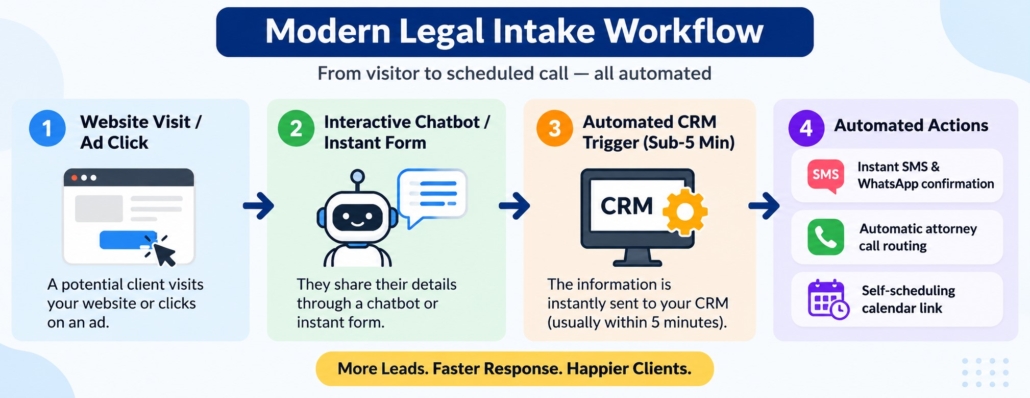
Top-performing law firms are replacing passive “Contact Us” forms with automated intake workflows. A combination of AI web chat, instant SMS notifications, and self-scheduling software ensures that leads are captured within five minutes, dramatically reducing client acquisition costs.
Authentic Short-Form Video & Visual Credibility
Legal services are built on trust. Prospective clients want to see and evaluate the lawyer who will represent them. Consequently, short-form video content on platforms like YouTube Shorts, LinkedIn, and Instagram has become a crucial means of acquiring clients.
Types of legal videos that drive higher conversions:
- FAQ Information: 60-second answers to essential legal questions (e.g., “What to do after a car accident”).
- Easy Case Understanding: Step-by-step information on common legal processes.
- Lawyer Introductions: Authentic, unscripted introductions to the firm’s legal team.
High-budget productions are no longer necessary. When lawyers create authentic, clear, and straightforward videos answering common questions, they instantly build a strong rapport. This gives potential clients confidence in their decision even before the initial conversation takes place.
E-E-A-T and Expert-Led Legal Content Architecture
Google’s search quality guidelines impose severe penalties on low-quality or generic legal content under YMYL (Your Money Your Life) standards. Generic or AI-generated blog posts published without legal oversight no longer rank well, and this can damage a firm’s digital reputation.
Demonstrating E-E-A-T (Experience, Expertise, Authoritativeness, and Trustworthiness) requires an expert-led content strategy:
- Legal Expert Details: Ensuring that all educational content is written, reviewed, or co-authored by verified lawyers.
- Real Case Summaries and Statistics: Publishing information on case outcomes, settlements, and court victories (while maintaining anonymity and adhering to local bar regulations).
- Original Legal Commentary: Providing timely analysis of recent legal changes or landmark court rulings.
Partnering with specialized SEO companies helps law firms create more trustworthy content, while their in-house legal teams can focus on casework.
Strategic Multi-Channel Paid Media & Smart Bidding
‘Pay-Per-Click’ (PPC) advertising remains one of the fastest ways to generate immediate case leads; however, legal keywords continue to be among the most expensive in digital advertising. Bidding on ‘broad-match’ keywords without ‘negative management’ can rapidly deplete an advertising budget.
Modern Multi-Channel Paid Media Strategy:
- Google Local Services Ads (LSAs): Pay-per-lead model featuring “Google Screened” badge verification.
- High-intent Google Search Ads: Exact-match commercial keywords combined with Smart Conversion Bidding.
- Retargeting and Social Proof Ads: Display and video ads showcasing client reviews to past site visitors.
In 2026, large law firms employ multi-channel advertising strategies managed by full-service digital marketing providers to balance costs. Combining Google Local Services Ads (LSAs) with audience retargeting ensures the acquisition of high-intent leads while keeping the overall cost-per-acquisition under control.
Transparent Fee structures & Client Experience (CX) Marketing
Consumer behavior research reveals a clear shift: clients want transparency. Studies show that over 70% of legal clients under the age of 45 prefer firms that clearly provide cost information online and offer direct communication.
Key digital transparency indicators:
- Pricing Structure Guide: Information on contingency fees, hourly rates, or flat-fee services.
- Direct Contact with Fee Earners: Profile pages featuring direct email addresses and phone numbers.
- Client Portal Integration: Real-time case status tracking and secure document management.
Law firm websites that provide clear information regarding billing, consultation stages, and case timelines attract site visitors at a significantly higher rate than firms that use vague messaging.
Website Accessibility (ADA Compliance) as a Ranking & Trust Factor
Digital accessibility is no longer just a matter of legal compliance, it is a crucial benchmark for website quality and user experience. An accessible site ensures that potential clients with disabilities, visual impairments, or mobility issues can access your legal services without any barriers.
Modern accessibility optimization includes:
- Screen Reader and Keyboard Navigation: Structuring HTML code so that assistive technologies can easily read the pages.
- Color Contrast and Dynamic Text Scaling: Ensuring text remains easily readable across various screen types and lighting conditions.
- Video Captions and Transcripts: Providing full text alternatives for audio and video media.
Search engines prioritize accessible websites with better technical quality scores, while broad accessibility extends your company’s services to a wider range of customers.
Digital PR and High-Authority Legal Backlinks
Backlinks remain a key factor in Google’s ranking evaluation. However, low-quality link schemes and spam directory submissions can lead to ranking penalties. Nowadays, building links effectively requires relying on digital PR and earned authority.
High-Authority Digital PR Earned Channels:
- Commentary on Legal Matters: Providing expert opinions or statements to news outlets regarding the latest and most significant news in the legal world.
- Bar Associations and Journals: Publishing articles based on original research or expert opinion in recognized legal publications.
- Sponsorship of the Local Community: Partnering with regional non-profit organizations, sports leagues, and civic programs.
By earning links from reputable media outlets, educational institutions, and local civic organizations, law firms build strong domain authority that safeguards their organic search rankings in the long run.
Summary of Law Firm Marketing Trends
| Marketing Trend | Core Focus | Expected Business Outcome |
| Generative Engine Optimization (GEO) | AI search visibility (ChatGPT, Gemini, Perplexity) | Inclusion in AI-synthesized legal recommendations. |
| Hyper-Local SEO & GBP | Google Map Pack & localized reviews | Higher volume of inbound phone calls from local clients. |
| Legal Schema Architecture | JSON-LD entity mapping for legal services | Enhanced machine indexing and search snippet features. |
| Automated Intake Systems | Sub-5 minute response via SMS & Chat | Increased conversion rates from web inquiries. |
| Short-Form Legal Video | Explanatory video content on social & site | Built-in client trust and higher engagement. |
| E-E-A-T Content Models | Attorney-reviewed, authoritative legal guides | Protection against core algorithm penalties. |
| Multi-Channel Paid Ads | Combined LSAs, PPC, and retargeting campaigns | Lower cost-per-client acquisition. |
| CX & Fee Transparency | Accessible pricing models and client portals | Higher conversion rate of high-net-worth clients. |
| ADA Accessibility | WCAG compliant website design & media | Improved technical SEO scores and broader reach. |
| Digital PR & Authority | Earned links from media and legal journals | Sustainable, high-authority organic rankings. |
Future-Proofing Your Law Practice
The gap is widening between law firms that adopt modern digital strategies and those that rely on traditional methods. In today’s landscape, winning legal clients requires technical precision, trustworthy content, rapid responses to inquiries, and a transparent experience.
Managing these technical workflows alongside a legal practice can be challenging. By partnering with an experienced digital marketing firm like Samyak Online, your practice can implement tailored AI SEO, schema architecture, local map management, and multi-channel paid media campaigns. This specialized support helps build a lasting online presence, allowing your legal team to focus on serving clients and delivering successful outcomes.
About the Author
Samyak Jain is an SEO and digital marketing consultant specializing in AI search optimization, local SEO, and content strategy. He helps businesses navigate the evolving search landscape to gain online visibility, build brand credibility, and generate measurable, high-value leads.
Frequently Asked Questions About Law Firm Digital Marketing in 2026
Traditional SEO focuses on optimizing keyword density, meta tags, and backlinks to rank among Google’s top blue links. Generative Engine Optimization (GEO) tailors your content for AI search engines like ChatGPT, Google AI Overviews, Gemini, and Perplexity. Instead of merely matching search terms, GEO structures your firm’s case histories, attorney bios, and legal guides so that when users ask complex, conversational legal questions, LLMs can easily retrieve and verify information positioning your firm as a trusted authority.
Studies show that over 80% of prospective legal clients expect a response on the same day, and more than 60% hire the first firm that contacts them. High-speed intake automation utilizes chatbots, automated SMS confirmations, and direct CRM call routing to engage leads within five minutes of their inquiry. This immediate response captures highly interested prospects before they reach out to other firms, significantly boosting conversion rates.
Since legal advice falls under Google’s “Your Money or Your Life” (YMYL) guidelines, search algorithms expect legal websites to adhere to strict standards of trustworthiness. Demonstrating Experience, Expertise, Authoritativeness, and Trustworthiness (E-E-A-T) requires articles to be written or reviewed by licensed attorneys, the publication of actual case outcomes, and the provision of original legal analysis. Generic or unverified AI-generated content faces penalties, whereas expert-crafted content sustains organic rankings over the long term.
Schema markup is structured code (JSON-LD) added to your website that helps search crawlers and AI bots clearly understand your firm’s data. Implementing ‘Attorney’, ‘LegalService’, and ‘Local Office’ schemas provides search engines with details regarding your practice areas, bar admissions, physical address, and consultation information. This increases the likelihood of your firm appearing in local map packs, rich snippets, and generative search summaries.
In a multi-channel strategy, both types of ads serve distinct purposes. ‘Local Services Ads’ operate on a ‘pay-per-lead’ basis and display a “Google Screened” badge at the top of search results, instantly building trust with people searching for services locally. Traditional ‘Google Search Ads‘ operate on a ‘pay-per-click’ model and target more commercial search terms. Using both channels together allows a law firm to maximize leads while keeping the overall cost of acquiring clients under control.
Ensuring your website complies with ‘Web Content Accessibility Guidelines’ (WCAG) helps individuals with visual or mobility impairments navigate your site using screen readers or keyboard controls. Beyond avoiding legal compliance issues, search engines award higher technical quality scores to accessible and user-friendly websites, enabling your practice to reach a wider audience of potential clients.
Short legal videos can help lawyers answer common legal questions, simplify legal processes, and introduce their teams. Authentic videos featuring lawyers directly answering questions can help potential clients understand the firm and build trust even before an initial consultation.
A specialized digital marketing agency can help manage SEO, GEO, Google Business Profile optimization, schema implementation, automated intake workflows, paid advertising, content, and digital PR. For law firms, this allows the legal team to focus on casework, while marketing specialists handle the technical and promotional aspects of the online presence.
Leave a Reply
Want to join the discussion?Feel free to contribute!