
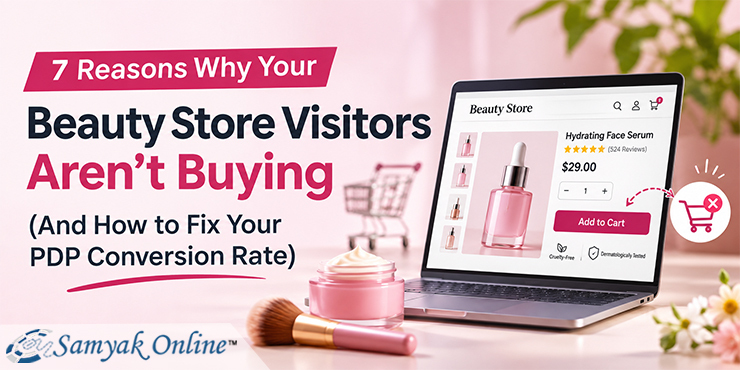
7 Reasons Why Your Beauty Store Visitors Aren’t Buying (And How to Fix Your PDP Conversion Rate
Key Takeaways
- Avoid oversimplification: Informed cosmetic shoppers require detailed ingredient lists, clinical validation, and clear usage instructions to feel confident in their purchases.
- Eliminate uncertainty in shade selection: Use interactive shade finders and images of real models to overcome the challenges often faced when purchasing color cosmetics.
- Establish immediate social proof: Place star ratings, verified reviews, and user-submitted photos at the top of the page to build instant trust.
- Showcase texture and application: Utilize macro images and looping videos to bring the “in-store sampling” experience to life online.
- Streamline the mobile user experience: Remove unnecessary pop-ups, ensure fast page-load speeds, and implement a persistent “Add to Cart” button for mobile shoppers.
- Integrate SEO and CRO: Combine a seamless Product Detail Page (PDP) layout with targeted search optimization to attract high-intent beauty consumers and drive them toward a purchase.
In the beauty, skincare, and cosmetics industry, your ‘Product Detail Page’ (PDP) effectively serves as your digital sales counter. While a typical Shopify store sees a conversion rate between 1.4% and 1.8%, top-tier personal care brands often achieve conversion rates of 4.7% to 6.8%, or even higher. When online traffic fails to convert into customers, the root cause often lies right on your PDP.
While removing page elements is generally considered standard practice in other eCommerce categories, shoppers looking for cosmetic products behave differently. Over-simplifying the presentation of your products can lead to a significant drop in your sales figures.
Here are seven key reasons why visitors to your beauty store leave without making a purchase. Also included are data-driven strategies to help improve your baseline performance.
To Know More, Click – Digital Marketing Services for Beauty Brands
1. Over-Simplifying the Page (Stripping Essential Product Clarity)
The Mistake
To achieve a modern and minimalist design, remove detailed descriptions, the complete list of materials, and step-by-step instructions for use.
Why It Drops Conversions
Conscious buyers of beauty and premium skincare products want to be fully informed about any product before applying it to their skin. A lack of detailed information immediately sparks suspicion; buyers may begin to wonder if the formula is truly unremarkable, or if your brand is deliberately concealing inferior ingredients and harmful fillers.
The Fix
Prioritize complete clarity over extreme minimalism. Organize dense information such as clinical trial summaries, skin-type compatibility matrices, and detailed descriptions of active ingredients into clean, expandable ‘accordion’ sections or ‘tabbed’ layouts. This maintains a clear visual structure while ensuring that discerning shoppers can instantly access comprehensive technical details.
2. The “Shade Matching” Roadblock
The Mistake
Relying on static, flat graphic swatches for complex products like foundation, concealer, powder, or lip color.
Why It Drops Conversions
Industry data indicates that 60% of customers purchasing beauty products online abandon their carts because they are unable to determine the right shade for themselves. Furthermore, the 40% of customers who make a purchase based on an estimate of their shade often end up returning the product. This incurs costs associated with processing returns, which in turn reduces your profit margins.
The Fix
Incorporate an interactive shade selection tool directly on the PDP (Product Detail Page). By adding an AI-powered skin tone analyzer that scans facial features, you can enable shoppers to accurately identify the perfect shade for them from various shade ranges. Additionally, include images of real-life models showcasing each shade across different skin tones (cool, neutral, and warm undertones) to help alleviate any hesitation shoppers might have about their purchase.
3. Missing or Unverifiable Trust Signals
The Mistake
Hiding customer reviews at the very bottom of the page, failing to show photos of actual customers, or not mentioning clear guarantees related to health and safety.
Why It Drops Conversions
Cosmetic products directly affect a customer’s physical appearance and skin health. If there is no clear social proof from actual users, buyers immediately become hesitant.
The Fix
Display the average star rating and the total number of reviews near the top of the page ‘above the fold’ directly beneath the product name. Include filterable customer reviews so that shoppers can find feedback relevant to their specific skin concerns (such as hyperpigmentation, dry skin, or rosacea). To build credible social proof, highlight authentic, unedited user-submitted photos, including ‘before-and-after’ images.
4. Technical Friction at the Variant Choice Step
The Mistake
Using layout patterns that are confusing or do not function properly when shoppers select options such as sizes, color swatches, scents, or recurring subscription bundles.
Why It Drops Conversions
When a customer clicks on a variant and the page slows down, the price doesn’t update immediately, or the main product photo fails to change automatically, the customer begins to feel frustrated. They start clicking around, become confused, and end up leaving your store.
The Fix
To identify UI bugs, conduct technical session audits using session recording software. Ensure that when switching between single purchases, volume bundles, or subscription tiers, the price display, product gallery, and inventory status update visually immediately and without any latency.
5. Lack of Tactile Experience (Visual Content Gaps)
The Mistake
Relying on generic stock photography, flat CAD renders, or images of a bottle taken from only a single angle.
Why It Drops Conversions
People who shop online cannot see, touch, or smell items before purchasing them. If they are unable to gauge a product’s weight, consistency, absorbency, or texture, placing an order can feel like a significant financial risk.
The Fix
Upgrade your PDP visual media to highlight texture and application. Incorporate macro photography that showcases how the formula whether a cream, serum, oil, or powder spreads across the skin. Additionally, include short, auto-looping video clips for instance, showing the use of a dispenser pump, the consistency of serum droplets, or the product being blended into the skin.
6. Ambiguous Shipping Promises and Hidden Return Policies
The Mistake
Leaving delivery estimates vague, or hiding return policies within the footer and the ‘terms of service’ pages.
Why It Drops Conversions
A customer might like your formula, but they may abandon the checkout process due to uncertainty regarding arrival dates for an upcoming event, or out of fear of being stuck with an expensive product that could cause breakouts.
The Fix
Directly below the main ‘Add-to-Cart’ button, display the delivery timeframe and a risk-reversal guarantee (a guarantee designed to reduce risk) using simple language. Instead of generic terms, provide clear and precise information, such as: “It will be shipped within 24–48 hours. If your skin doesn’t agree with this formula, you can return it within 30 days, hassle-free.“
7. Overwhelming UX Elements and Distracting Animations
The Mistake
Cluttering the viewport with discount spin-wheels, persistent promotional pop-ups, chat widgets, and heavy animation scripts.
Why It Drops Conversions
Visual storytelling is essential for beauty branding, but intrusive pop-ups degrade the user experience, slow down mobile page speeds, and distract shoppers ultimately preventing them from completing their purchases.
The Fix
Check page speed metrics on both mobile and desktop devices. Remove any unnecessary third-party apps or widgets that slow down page load speeds. Keep the checkout process simple and clear; on mobile devices, a prominent, fixed “Add to Bag” bar should remain visible at the bottom of the screen while scrolling.
Diagnostic Framework: Identifying Your Conversion Bottlenecks
To identify where visitors are leaving the site, map out a drop-off funnel in your analytics dashboard:
| Funnel Step | Drop-Off Point | Primary Root Cause | Recommended Corrective Action |
| Top of Funnel | Visits → Product Views | Unfocused ad targeting or confusing navigation structure | Audit acquisition channels and streamline top navigation categories. |
| Middle of Funnel | Product Views → Add-to-Cart | Missing trust signals, lack of ingredient details, or shade uncertainty | Add reviews above the fold, embed texture videos, and add an AI shade finder. |
| Bottom of Funnel | Add-to-Cart → Completed Purchase | Unexpected shipping costs, missing local payment options, or checkout lag | Add clear delivery dates near the CTA and audit mobile checkout flows. |
Maximizing Growth with Professional Digital Marketing
Improving your PDP design is just one part of a broader growth strategy. To attract the right customers to a store that converts well, you must create an integrated system that combines the site’s technical health, its visibility on search engines, and the channels used to reach your target buyers.
Implementing effective SEO for beauty brands ensures that your product pages rank prominently on search engines especially when customers search for specific items, such as “hyaluronic acid serum for sensitive skin” or “cruelty-free full-coverage foundation.” Combining search engine optimization with other digital marketing services such as Google Shopping campaigns, social media promotion, and the collection of customer reviews creates a reliable ecosystem. This ecosystem transforms casual visitors into repeat customers who return to shop with you again and again.
Partnering with an experienced digital marketing agency allows your brand to implement SEO services and conversion rate optimization (CRO) strategies specifically tailored for the personal care sector.
Connect with Samyak Online
Are you ready to overcome obstacles in your eCommerce store, boost your search visibility, and increase your online sales? Connect with Samyak Online today to discover a customized growth roadmap for your beauty and cosmetic brand.
About the Author
Samyak Jain is the Digital Marketing Head at Samyak Online, where he leads strategic execution across SEO, content marketing, and AI/LLM search optimization. With a principle of “performance with purpose,” he specializes in helping healthcare, eCommerce, and global brands build long-term organic authority and adapt to AI-driven search trends.
Frequently Asked Questions About Beauty PDP Conversion & Marketing
While the average conversion rate for a typical eCommerce store ranges between 1.4% and 1.8%, top-performing brands in the beauty, skincare, and cosmetics sector often achieve conversion rates of 4.7% to 6.8%. Since personal care products directly impact skin health and appearance, optimizing your ‘Product Detail Page’ (PDP) is essential to reaching such high levels of performance. This should include trustworthy visual content, a detailed list of active ingredients, and verified user reviews.
While minimalist web design may be suitable for simple consumer goods, conscious shoppers looking for cosmetic and skincare products require detailed information before making a purchase. Omitting details such as a list of active ingredients, summaries of clinical trials, or usage instructions can trigger suspicion among customers. They may fear that the brand is hiding cheap fillers or harmful chemicals, prompting them to leave the site and seek information about products from other brands instead.
Industry research indicates that up to 60% of customers purchasing cosmetics online abandon their carts because they are unsure about choosing the right shade. Furthermore, 40% of those who make a purchase based on guesswork end up returning the product. An AI-powered ‘shade finder’ tool identifies the perfect shade for customers by scanning their skin’s undertones. This instantly resolves any uncertainty regarding the purchase and lowers the product return rate, thereby helping to avoid potential losses.
Some of the most effective trust signals on the Product Detail Pages (PDPs) for personal care products include: an average star rating displayed near the top of the page, filterable customer reviews, photos from verified purchasers, badges indicating dermatological testing, and clear guarantees (such as a 30-day easy return policy). Allowing customers to filter reviews based on their specific skin concerns such as acne, hyperpigmentation, or rosacea further strengthens this ‘social proof.’
Customers who purchase beauty products online cannot touch, smell, or test them before buying. Standard product photos often fail to convey the consistency of a formula, how quickly it absorbs into the skin, or how it looks once applied. Close-up (macro) images of creams, serums, or powders on actual skin along with short, looping videos showing drops emerging from a pump digitally replicate the experience of “trying out samples in-store,” thereby reducing customer hesitation and the perceived risk of the purchase.
More than 70% of traffic related to beauty and skincare comes from mobile devices. Large, uncompressed image galleries, intrusive promotional pop-ups, and unnecessary third-party scripts slow down page load speeds. If a Product Detail Page (PDP) takes more than three seconds to load, potential buyers often leave the site immediately. Ensuring fast technical performance and implementing a ‘sticky’ (always-visible) “Add to Bag” bar at the bottom of the mobile screen helps ensure a seamless, uninterrupted shopping experience.
For beauty brands, Search Engine Optimization (SEO) attracts organic traffic that is actively seeking a specific solution such as a “hyaluronic acid serum for sensitive skin.” Meanwhile, Conversion Rate Optimization (CRO) ensures that visitors arriving at your Product Detail Page (PDP) turn into paying customers. The combination of technical search optimization and a user-friendly PDP layout creates a sustainable, long-term growth engine for your store.
Partnering with a specialized digital marketing agency provides your brand with access to expert technical SEO, targeted Google Shopping campaigns, conversion-focused web development, and review management software. Contact ‘Samyak Online’ today to have your existing store’s performance audited and to implement a customized, multi-channel growth roadmap designed to increase your online revenue.